Monday, January 4, 2016

The end of 2015

I wrote nothing for almost a year, because I had a tough year: my grandmother was slowly fading away in her bad for 10 months. It was hard enough both physically and emotionally, but it was doubly worse due to her spiteful nature. It is quite exhausting to take care of the person, who considers you almost an enemy, isn't it? Now this is over, but some time is necessary for a complete recovery. During this year I maintained my mental health with language learning and some games, and this is what I have to say:

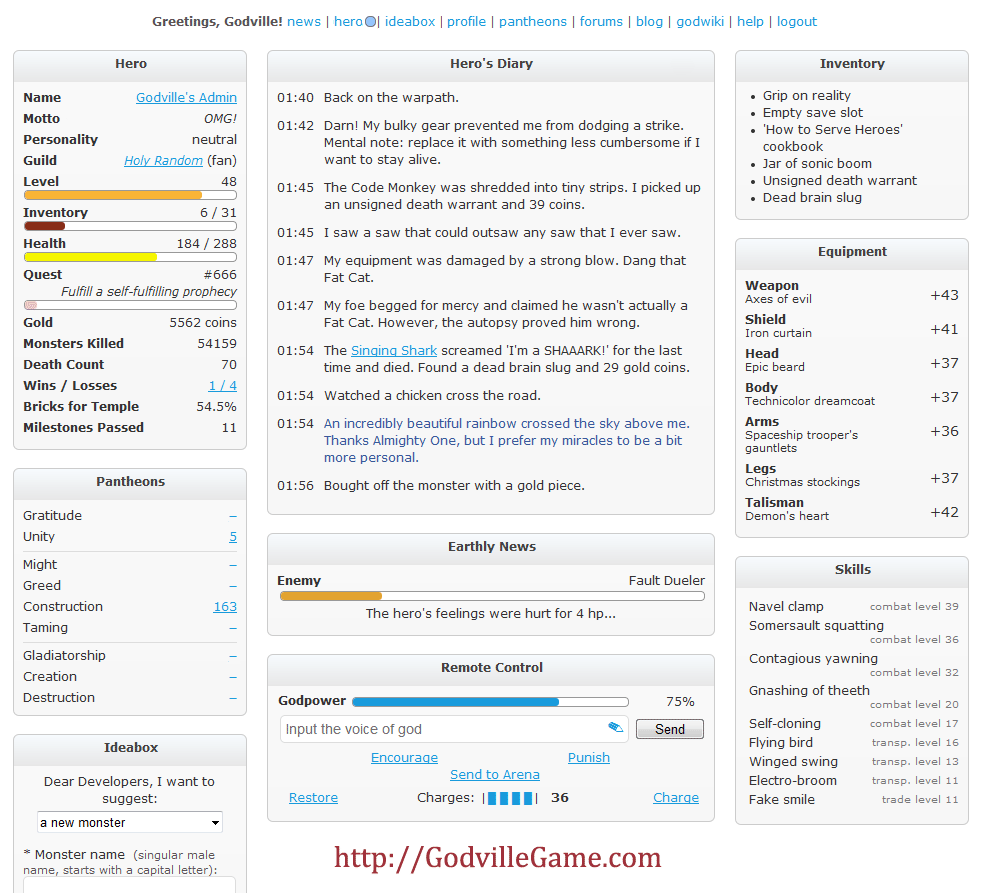
  • Last year saw a rise of so called "idle games". Previously there were some games in this genre: Progress quest - RPG, where you could create a hero and then only to watch his activity without any interaction; Godville - the game, about which I wrote earlier, where players have limited possibilities to interact with hero and several other games. But in 2014 Cookie Clicker appeared. Basically it is a game where you... click a Cookie.

Yes! You just click this cookie and gain money. Money can be spend on the upgrades - like getting more money with each click and, more importantly, on earning the money automatically. The main feature is that money continue to be earned even when the game is closed = idle. Also many games have a so called "prestige system", when the progress in the game can be reset to get some additional bonuses. There are big upgrade trees in some games, the games themselves could be really different But the core is the same in most idle games - players click something to earn money, which are spend on upgrades for earning more money. And money can be earned with the game closed. That's it! Sounds strange? But these games earn there share in the market. At first they appeared as browser games on Flashplayer, Unity, HTML 5 or something like this. Then they became popular on mobile devices, for example, "Tap Titans" have more than a million votes and 5-10 million plays.
And idle games earned their place on Steam. So why such a popularity? Firstly, they are really addicting! Try, if don't believe... You click - and there is an immediate reward. Figures grow fast. Achievements can be earned. And so on... Secondly, they can be played even with little free time. Thirdly, after some time most games turn from micro to macro managing which is also interesting.

I spent a lot of time on them and it was fun. But I'm glad, that I was finally able to drop them, as they could consume a lot of time.
  • As a part of deepening my knowledge of Japanese I continued playing visual novels. One of classifications could be based on the presence of gameplay in the game or it's absence. In some games gameplay is quite unique and captivating with no need to repear something. But some companies produce games with an insane amount of grinding! I think that some MMORPG have less grinding. For example, let's take a game "創刻のアテリアル" with a card-based battle system.
There are heroes which can receive experience and level up for bonuses? Cool! But there are 33 levels and heroes can't be leveled to max level in one game...
Cards can receive experience and grow? Cool! But cards receive only 1-4 points of experience in each battle (100 points are necessary for a level up), and cards can have up to 9 levels (so up to 900 battles to max one card)...
Some cards can be crafted? Cool! But for one high level card several cards of a lesser level and tenths of ingredients can be required...
And this isn't a full list! And this isn't the most grindy visual novel I met either.

On the other hand I have read a visual novel without gameplay called "Dies Irae". It was fantastic. Epic story with really different routes; many unexpected twists - you never know who will live and who will die, main hero don't always win and so on; wonderful art; memorable characters; and author likes to you quotes in different languages - "Faust" by Goethe, some French phrases, German hunting songs, Latin requiems and many others. I was enchanted and fascinated by the story and definitely will read it once again.


  • Speaking about language learning. For Spanish I have found an excellent free audio course. The essence is making you not to just learn a language, but to think. The form of the course is a dialogue between a teacher and a student. At first we are shown that there are a lot of words in Spanish which can be guessed from English, or more precisely from Latin. Then we learn general structures. verb tenses and other things. The course is 14,5 hours long and gave me more than several months of self study.
  • And once again I realized or remembered that learning a language requires an immersion. So now my mobile phone is in Spanish, my browser is in Spanish, I follow Spanish pages in my social networks, read in Spanish and even try to think in Spanish. The progress can be really felt.
Well, there were other things in my life, of course. But that's it for now. I'll try to write more regularly from now on.

Sunday, January 25, 2015

Learning Spanish - week 8


This week was mostly spent on learning through reading news. Main purpose was acquiring new words. I found two good news portals and read 2-3 articles every day on various topics.
For this I used a program Foreign Language Text Reader (FLTR) (the screenshot if from it). It is very similar to LWT, which I described ~a year ago. For me this program is even better than LWT; of course there are some disadvantages, but they aren't really important for me:

  • Though it is local (now web) I can use it from several computers by placing the program in Dropbox;
  • No audio support - don't care, can use my local media player;
  • Little statistics, just word count - anyway I don't use it;
  • Can't test words in the program - don't care as I use Anki;
  • And for for benefits. It is fast, free and supports all languages;
  • Flexible template customizing, which allows to export data in a file, which can be imported to Anki;
  • Easy to manage data - texts and words;

The only problem of all these programs is word forms: different forms of a word are analyzed as different words.
It is understandable - each language has it's own rules of words' changing. It would be necessary to program separate logic for each language. And even in that case there will be problems - in many languages one word can belong to one of several parts of speech depending on context (for example, "I filed the cards in alphabetical order" and "I order new clothes every year").
I almost accepted this inconvenience, but by chance I found an elegant solution... for Japanese. You input a verb and the program generates all its forms. The result can be exported to FLTR. This way all the verb forms will be marked and translated.
I wondered how was it done - maybe the program uses functionality from some website and shows the result. Maybe I could use it for Spanish. So I looked into the code - it wasn't what I expected. The author just described grammar rules with code: he coded the rules of verbs' conjugation for each possible case. No luck for me.

So now I just make notes for new words and don't spend time on making cards for different forms of known words.

So two months of studying Spanish passed.
During these days I was able to build a good foundation for studying Spanish language. I know enough grammar and words to read news on random topics with a moderate comprehension. Now only more immersion and practice is necessary. Several next weeks will be spent on reading news and articles. Then I'll read more books. And on one of my bookshelves "Cien años de soledad" is waiting. The journey to the depths of Spanish language is only beginning...

Sunday, January 18, 2015

Learning Spanish - week 7


Finished this book. It was really interesting: intricate story, memorable characters, nice ending and so on.
Listening to the Spanish audio book while reading English text is really useful. I learned a lot of new words and phrases. Also i was able to notice flaws in translation: errors in certain phrases, missing sentences, misinterpretations and others mistakes. I hope one day to read this novel again and in Spanish.
In the following week I am going to try read newspapers. I have already tried it - rather difficult, but definitely not impossible.

Sunday, January 11, 2015

Learning Spanish - week 6


This week I also practiced Spanish mostly by reading parallel texts while listening to audio.
I found a good site with several ready to use parallel texts with audio. It's a pity that only beginner and intermediate texts have audio. Nevertheless they are quite useful.
Also after acquiring some foundation and immersion I decided to try something more challenging. So I found the Spanish text of "La sombra del viento" and it's English translation (The Shadow of the Wind) as well as Spanish audio-book. This novel is a worldwide bestseller. It's quite big for a language learner - ~300 paged and 19+ hours of audio. But the more the better :)
As of now I went through the first third of the book. Naturally at first it was quite difficult, but the process is becoming more smooth and now I'm beginning to enjoy the book. This way of learning is quite fun.

Sunday, January 4, 2015

Learning Spanish - week 5


During this week I tried to immense in Spanish more. Again method Listening-Reading was used.
I decided to try Harry Potter again as this book can be easily found in many languages. So English and Spanish ebooks and Spanish audio book (this was tricky to find, but i succeeded in the end). I have listened to this audiobook while reading the English version. Sometimes I have read Spanish version to check whether I have heard certain words correctly.
This was really effective so I'm going to continue using this method for some time.

Wednesday, December 31, 2014

The results of the year


2014 year is coming to the end. Many things happened during this time in the world, be they good, bad or something else. There were also events, changes and new things in my own life. So it's good idea to remember what have this year brought to me.

  • Realized that I like learning languages. Not only it grants access to a whole new world of possibilities, not only it helps to train brain, but it is fun by itself. For example, there is a strange and unknown text. At first it is like a cipher text. But then you begin to unravel in step by step. Of course, there are some known words. Then some loanwords can be understanded. More words are guesses from the context. Inevitable, dictionary is used for unknown termins. And now you know what this text is about. You continue reading texts this way for a long time until something changes. You don't need the dictionary anymore. Sure, the comprehension rate of the texts isn't 100%, maybe it is just 60-80%, but it doesn't matter. If you see a sentence like "Evil pirates and their dastardly deeds should be punished!" and you don't know the meaning of "dastardly", this lack of knowledge doesn't impede your apprehension of the sentence. And also a general meaning - a bad characteristic - can be derived from the context. This means a quality change in the knowledge of the language and it inspires to continue studying it;
  • Experienced more deeply the fact that it is very difficult to change a person's point of view and his opinion on the matters. Especially if this is convenient for that person. The person can be your relative, close person, friend, colleague, stranger with whom you have to communicate or someone else. The first problem is that most people don't like to have direct conversations. They prefer to be angry, disappointed, stresses by themselves or tell about these problems to other people, but not to talk with the one who causes these problems. Mostly this course of actions ends in quarrels and possibly break-ups. The second problem is inability to listen. It is much easier to speak, to impose one own views or just to ignore the words of others. Another problem is the people prefer to endure the problems rather than find solutions to them. Of course there are much more problems that those which are written here. But in the end the result is that people often stick to their ways as long as possible. From time to time - they do it too long and make the problems irreparable. And this is sad;
  • Acquired the confirmation of the idea that the fact that someone is your relative can be a foundation for relationships between both of you, but it can be not enough to maintain them. If the relationship is one-way -  good things are done only in one direction and bad things are done in the opposite direction, then it can be better to cut these ties off. Or they will continue and will bring only pain and problems;
  • Making big changes is really difficult. It is much better to stay in the comfort zone. It is more simple to stay the way you are. But one should remember the meaning of the words of Lewis Carrol "we must run as fast as we can, just to stay in place. And if you wish to go anywhere you must run twice as fast as that". If you want to improve, to become better, to try something new, to reach success you have to change. This isn't easy, but it can give big rewards. I tried different ways of beginning a change: little steps which steadily brought me to the target or a sharp (and in some cases painful) jerk. Sometimes I failed. Even when i was able to change I felt the urges to stop it, to revert back. But when I was able to meet the target, the success inspired me to do more. And it was nice;
  • Health is really important. A little health problem can cause painful consequences later. Little early care can prevent it. Some work on the health can bring big positive effects in the coming years. Health is with us for the length of the life, so it better be good. So why not improve it? So I started active exercises. Hope I'll be able to do it long enought to have some results;
  • Once more remembered that I like reading. For several years I have been reading business books, manga, visual novels, textbooks, articles and so on. A lot of time was spent on learning languages. Oh, of course I read normal books, but they got buried in the flow of other things. This year I made a break and tried to read something good and big again. And I was able to remember the joy of it: imagining the world and trying to live in it, following the heroes and empathizing with them, forgetting the things happening around me, wishing to continue reading, coming up with an alternate course of actions or a continuation of the story and so on. As a result I have read more than 40 books and some fanfiction. It can amount to 5-8 mln of words, I suppose. I hope to continue reading a lot in the next year;

Sunday, December 28, 2014

Learning Spanish - week 4


This was the last working week in 2014, so I was busy. Sadly it negatively impacted the time which I could spend on learning Spanish.
Mostly I just repeated the lessons on Duolingo.

Also I tried reading some Spanish news. At the first look it was like "A mysterious text with several known words". Then I tried to use my brain more and realized, that it's not that bad. Surely there were many new words and sometimes unknown grammar, but thanks to the title I knew the general content. And many words could be just guessed :)

Next week I'll have more free time, so I'll try another method of studying.

P. S. A couple of days ago I found a wonder full game - godville. It is a text RPG. And it is almost a zero player RPG - this means you can't influence most of the things which happen. The hero fights monsters, earn money, buy equipment, drink in taverns and writes entries in his dairy about each action. This is really fun :) In fact with levels you (the god of the hero) receive some possibilities to take part in the game more actively. And you can encourage or punish your hero. Or just tell him something. I liked this game!
And I found out that the original version is in Russian and it started 7 years ago. So I registered in the Russian version and began this fun adventure.


Sunday, December 21, 2014

Learning Spanish - week 3


Today I finished Spanish (from English) tree on Duolingo!
This was quite challenging. I learned a lot of Spanish words and some of its grammar. Due to high speed many things weren't remembered good enough though.
For all it merits, Doulingo has also disadvantages - grammar isn't explained adequately. And for many grammar points there is no explanation at all. Also the balance of exercises isn't really optimal I think - I'd prefer more exercises of translating English into Spanish.
But well, you can't hope to learn language from one sourse. So I also used additional sources to study grammar. The question is what to do next. I suppose I'll do the following things:

  • Review the spanish tree (by using "strengthening skills") and translate articles in "Immersion" section;
  • Begin duolingo courses in Spanish for learning English and German. The former will provide more opportunities to practice translation into Spanish, the latter will give an additional benefit of strengthening German;
  • Try to start reading Spanish news;

Sunday, December 14, 2014

Learning Spanish - week 2


This week I learned more about verbs.
Bad thing: there ~17 tenses in Spanish.
Good thing: only 5 or 6 of them are commonly used.

Bad thing: depending on the person (1st/2nd/3rd, singular/plural, casual/polite) verbs can have one of 6 different endings in each tense.
Good thing: at least this allows to drop personal pronouns. For example: "I am tall" can be written as "Yo soy alto" or just "soy alto".

Bad thing: there are ~200 commonly used irregular verbs in Spanish.
Good thing: most of them can be classified in patterns.

As any language Spanish has easy and difficult points. It just takes time to learn them.
For now I have an open point about the way of learning the conjugations.

I still remember how I studied the conjugation of irregular verbs in English language.
I was somewhere in 1-3 grade and had a private language tutor. She made me drill all the irregular verbs one by one. It was boring as hell and took a lot of time, it was repetitive and non-inspiring. But as a result even now I remember forms of most verbs by heart. So it was really effective.
But I'm not sure that this way will apply to Spanish good enough, as there are much more forms in it.
For example let's take English verb "to speak" and see it forms in present and past:
speak, speaks, spoke... and that's it.

Now the Spanish analog - "hablar".
hablo, hablas, habla, hablamos, habláis, hablan, hablé, hablaste, habló, hablamos, hablasteis, hablaron.
And this is a regular verb!

Now you get the idea.

So at first I'll try to learn just patterns.

Sunday, December 7, 2014

Learning Spanish - week 1


So I began learning Spanish last weekend. It was mostly Duolingo. ~700 words are in the vocabulary. Not sure how many of them I really know :)
In fact a lot of words weren't really new.
Some words are exactly the same as in other languages, for example "the animal" is "el animal" or "библиотека" is "la biblioteca".
Some words are almost the same as "der Pistole" and "la pistola" or "the calender" and "el calendario". 
Spanish, as many other languages, has many loan words, so this makes things easier.
Also in some cases things are simpler due to the endings - the world ending can change the gender the word, so that you need to learn only one word and not two:
la gata/el gato - the female/male cat
la hermana/el hermano - the sister/brother

But, of course, not everything is easy. For example, Spanish has more pronounce: they distinguish between "him" (lo) and "to him" (le). Also verbs have much more endings. In some cases word order is different.

During this week I learned several hundreds of most common words and the grammar for basic conversations. Next week I'm going to concentrate more on verb forms.

Anyway, learning a new language is a really interesting experience :)